


A Hoi An self-guided trip is the best way to enjoy this UNESCO-listed ancient town at your own pace. You can wander between old merchant houses, family chapels, the Japanese Covered Bridge, small museums and street food stalls.
📌 Source: KCT Travel · Updated: October 2026 · Since 1 July 2025, Quang Nam province has been merged into Da Nang city. Prices are indicative.
🏮 Hoi An self-guided trip: why go?
Hoi An’s Old Town still keeps its old Japanese merchant houses, Chinese temples and tea warehouses. Many of them are now shops, cafes and tailors.
Bars, boutique hotels and travel agents are part of the scene today. Yet around the market and on Cam Nam island, local life feels slow and simple.
Go a few kilometres out of town and you will find easy bicycle, motorbike and boat trips. Quiet beaches and rice fields are close by too.
🗺️ What to see in Hoi An Ancient Town
⛩️ Tran Family Chapel
📍 View on Google Maps · Map 21 on the town map below
This family chapel was built in 1802 to worship the Tran ancestors. It was commissioned by Tran Tu, a clan member who became a mandarin and an envoy to China.
The building mixes Chinese, Japanese and Vietnamese styles. Look for the “turtle” roof, the triple beams and the bow-and-arrow carvings.
The central door is opened only at Tet and on the anniversary of the main ancestor. In the past, women entered from the left and men from the right.
Wooden boxes on the altar hold the ancestors’ stone tablets with their dates of birth and death. On each anniversary, the box is opened and offerings are made.
At the end of the short tour, you will see a room selling old coins and souvenirs.
🏠 Phung Hung Old House
📍 View on Google Maps · Map 4 on the town map below
This old house sits just a few steps from the Japanese Covered Bridge. Its wide hall is decorated with lanterns, embroidery and wall hangings, and there is a balcony and a hanging altar.
🌉 Japanese Covered Bridge
📍 View on Google Maps · Map * on the town map below
This little bridge is the symbol of Hoi An. The Japanese community first built it in the 1590s to link their quarter with the Chinese quarter.
The decoration has stayed close to the original Japanese design. The French once flattened the road for cars.
The arched shape was restored in 1986. The bridge has also been under major repair in recent years, so check that it is open before you go.
The bridge is very solid because of the risk of earthquakes. A pair of monkey statues guards one end and a pair of dog statues guards the other.
One story says many Japanese emperors were born in the years of the dog and the monkey. Another says the bridge was started in a year of the monkey and finished in a year of the dog.
The stone steles list the people who paid for later restorations. They are written in Chinese characters.

🛕 Quan Cong Temple
📍 View on Google Maps · Map 24 on the town map below
Built in 1653, this small temple honours Quan Cong, a Chinese general who stands for loyalty, honesty and justice.
His gilded statue sits on the main altar. When someone makes an offering, the caretaker strikes a bronze bowl that rings like a bell.
To his left stands General Chau Xuong, his guard. To his right is the mandarin Quan Binh. The life-size white horse is Quan Cong’s mount.
Check out the carp-shaped rain spouts on the roof surrounding the courtyard. The carp is a symbol of patience in Chinese mythology and is popular in Hoi An.
Shoes should be removed when mounting the platform in front of the statue of Quan Cong.
🏺 Museum of Trading Ceramics
📍 View on Google Maps · Map 80 on the town map below
This restored wooden house holds a small collection of trade ceramics from across Asia and beyond. It shows how far Hoi An’s trading links once reached.
The display is quite specialised. The section on restoring Hoi An’s old houses is a good short lesson in Old Town architecture.
🏮 Handicraft Workshop
📍 View on Google Maps · Map 9 on the town map below
The workshop is in a 200-year-old Chinese trading house. In the back, artisans make silk lanterns and do traditional embroidery.
In the front there is a short cultural show with traditional music, singing and dancing. It is a pleasant break from sightseeing.

🎎 Museum of Folklore in Hoi An
📍 View on Google Maps · Map 33 on the town map below
This museum sits in a 150-year-old Chinese trading house and shows local customs and crafts. The best part is the view of the river from upstairs.
🗿 Museum of Sa Huynh Culture & Museum of the Revolution
📍 View on Google Maps · Map 149 on the town map below
Downstairs you will see jewellery, ceramics and burial jars from the ancient Sa Huynh culture. The upper floor is a small museum about the revolution.
🏛️ Hoi An Museum of History & Culture
📍 View on Google Maps · Map 7 on the town map below
Set in the Quan Am Pagoda, this museum shows pre-Cham, Cham and trading-port objects, including big bells, old photos, scales and ceramics.
🏡 Tan Ky House
📍 View on Google Maps · Map 101 on the town map below
A Vietnamese family built this house about two centuries ago, and seven generations have looked after it. You can see Japanese and Chinese touches in the design.
The ceiling in the sitting area rests on three stacked beams, a Japanese feature. Below it are carvings of crossed swords wrapped in silk.
The swords stand for strength and the silk for flexibility.
Some columns carry Chinese poems inlaid with mother-of-pearl.
Look closely: each character on these old panels is made of small birds in flight.
🍜 What to eat in Hoi An
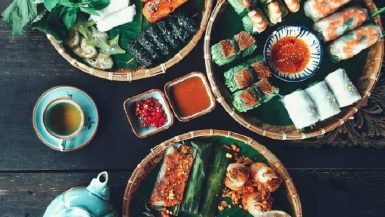
The Old Town has food for every budget, from smart restaurants to riverside stalls.
Noodle and rice dishes usually cost about VND 20,000–50,000. Snacks such as banh xeo and banh mi are cheaper. Here are the dishes not to miss.
🍜 Cao Lau (Rice Noodles With Barbecued Pork, Greens
And Croutons)
Cao lau is Hoi An’s signature dish: chewy rice noodles with barbecued pork, bean sprouts, crispy croutons, herbs and a little rich gravy.
Locals say the real noodles need water from old Cham wells, and the greens come from Tra Que vegetable village.
Most restaurants in town serve cao lau for about VND 50,000–100,000.
Some places add peanuts, rice crackers, spring onion, lime and chilli jam. 📍 Trung Bac restaurant, 87 Tran Phu.

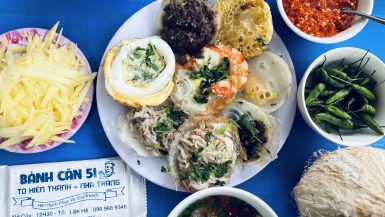
🥟 Banh Bao Vac (White Rose Dumplings)
These “white rose” dumplings are filled with shrimp or pork and steamed in thin rice dough.
They are served topped with fried shallots and a dipping sauce of shrimp broth, chilli, lemon and sugar. Most local restaurants have them.
Many restaurants buy them from one family workshop on Hai Ba Trung Street, where you can watch them being made. A plate costs about VND 50,000–70,000.
📍 533 Hai Ba Trung Street

🍗 Com Ga (Chicken Rice)
Com ga is rice cooked with chicken stock, topped with shredded chicken, herbs, black pepper and chilli jam.
The rice is cooked with pandan leaves, chicken stock and turmeric, which gives it a pale yellow colour.
A plate costs about VND 40,000–100,000 and comes with clear soup, sauces and pickled chillies. 📍 Ba Buoi, 22 Phan Chu Trinh.
📍 Ba Nga, 8 Phan Chu Trinh.

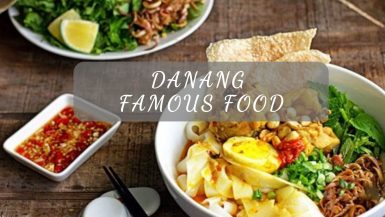
🍲 Mi Quang (Vietnamese Turmeric Noodles)
Mi quang is turmeric rice noodles in a small amount of rich broth, topped with meat, herbs and greens.
A bowl costs about VND 25,000–50,000. The usual toppings are chicken, pork or beef.
Many places now add shrimp, quail eggs or even frog. Like most Vietnamese noodle dishes, it comes with plenty of fresh herbs.
Expect peanuts, banana flower and a sesame rice cracker on the side. 📍 Mi Quang Ong Hai, 6A Truong Minh Luong.

🥖 Banh Mi (Vietnamese Baguette)
Banh mi is the Vietnamese baguette sandwich you should not miss. It costs about VND 25,000–40,000.
Fillings usually include pickled vegetables, pâté, butter, herbs and chilli, plus your choice of meat.
Popular choices are roast pork, fish cake, pork sausage, grilled pork, fried egg or Chinese barbecued pork.
📍 Banh Mi Phuong, 2B Phan Chau Trinh


💡 Tips for your Hoi An self-guided trip
- 🎫 Most old houses and museums need the Ancient Town ticket – buy it at a ticket booth when you arrive.
- 🚶 The old town is small and best explored on foot or by bicycle.
- 🏮 Stay until evening – the lanterns along the Thu Bon river are the highlight.
- 👟 Remove your shoes where asked in temples and family chapels.
💌 A note from Ken
It is hard to share everything Ken knows in one post. If you need more information about Hoi An or central Vietnam, feel free to contact Ken. Vietnamese readers can also read địa điểm du lịch Đà Nẵng.
- Email: phuotkct@gmail.com
- Fanpage: KCT Phượt
- TikTok: Phượt KCT
- YouTube: Phượt KCT
Phượt KCT. travel to remember, to tell &. to come back a better version of yourself!

Để lại bình luận